
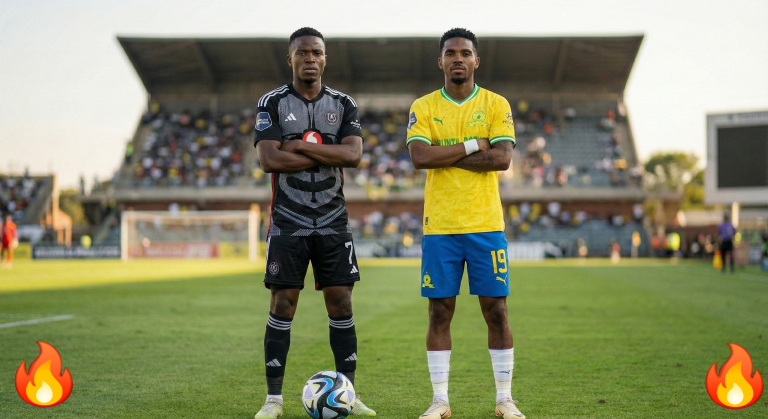
In the high-stakes arena of the 2025/26 Betway Premiership, the title race is being defined not just by points accumulated. Instead, it is defined by the tactical mastery of its most creative talents.
The battle for supremacy between Orlando Pirates and Mamelodi Sundowns has found its sharpest focus in a duel of two supreme playmakers: Relebohile Mofokeng and Tashreeq Matthews.
A new tactical analysis graphic, titled “Danger Zones: The PSL’s Elite Playmakers,” has provided a stunning visual representation of this rivalry. It lays bare a fascinating truth. While both players wear the “playmaker” tag, their methods of destruction could not be more different.
They are the architect and the assassin, two distinct weapon systems operating at the peak of South African football.
This isn’t just a comparison of stats; it’s a study in contrasting football philosophies that could decide the destination of the league title.
The Creative Connector: Relebohile Mofokeng’s Magic in the Half-Space.
On the left side of the tactical divide stands Orlando Pirates’ golden boy, Relebohile Mofokeng. At just 21, his market valuation has skyrocketed to R38 million, and the heat map explains why.
As the graphic illustrates, Mofokeng’s “Danger Zone” is heavily concentrated in the left “half-space”—that crucial pocket of grass between the opposition’s fullback and center-back. He is the archetypal modern “inverted playmaker.”
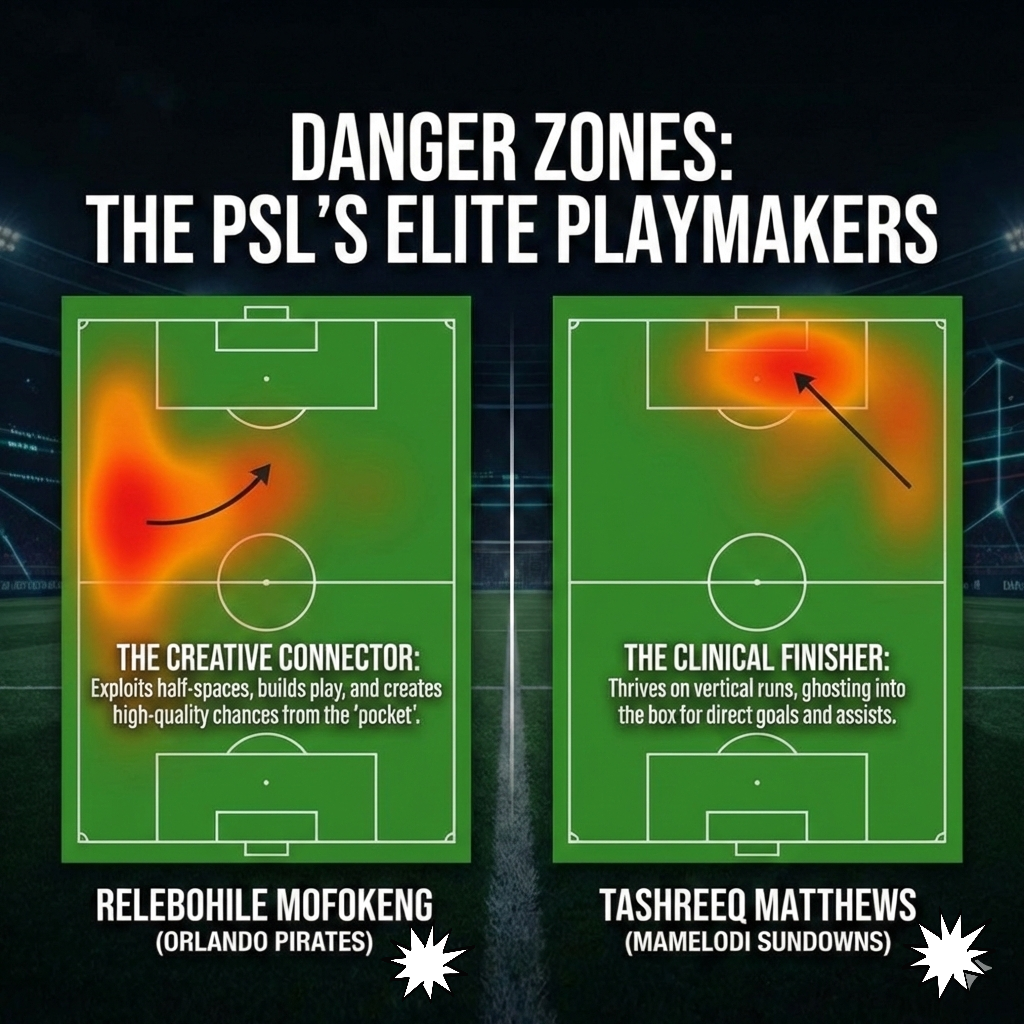
Unlike traditional wingers who hug the touchline to provide crosses, Mofokeng uses the wide areas merely as a starting point. The arrow on his heat map signifies his trademark movement. He receives the ball wide and immediately drives diagonally inward onto his favoured right foot.
This movement causes chaos for defenses. By drifting inside, he drags defenders out of position, opening overlapping lanes for teammates like Deon Hotto.
Mofokeng doesn’t just wait for the final ball; he builds the entire attacking sequence. He thrives in tight spaces. Furthermore, he uses his low center of gravity to turn away from pressure and thread passes through the eye of a needle.
He is the heartbeat of the Pirates’ attack, the “connector” who turns possession into dangerous penetration.
The Clinical Finisher: Tashreeq Matthews’ Ruthless Efficiency
Conversely, Mamelodi Sundowns’ Tashreeq Matthews represents the pinnacle of ruthless, European-honed efficiency. His side of the graphic tells a story of verticality and end-product.
Matthews’ heat map is terrifyingly focused. The red zone isn’t out wide; it’s right in the heart of the penalty area, specifically around the penalty spot and the back post. While Mofokeng is busy orchestrating the build-up, Matthews is often preparing for the kill.
READ Riveiro: “Sundowns isn’t a joke”
The straight arrow pointing into the box on his graphic perfectly captures his style. Matthews is a master of the “ghost run.” He has an innate understanding of timing, often arriving late into the box undetected to apply the finishing touch. He doesn’t need 50 touches on the ball to influence a game. In fact, he might only need five, provided two of them end up in the back of the net.
In a star-studded Sundowns team that dominates possession, Matthews doesn’t need to be the primary creator. Instead, he operates as a pseudo-striker drifting in from the wing. He provides the clinical edge that turns Sundowns’ intricate passing triangles into goals.
The Verdict: Different Tools for Different Jobs
The “Danger Zones” graphic highlights a beautiful tactical divergence in the PSL.
If you need a player to unlock a stubborn, low-block defense through sustained pressure, dribbling, and creative passing in tight pockets, Relebohile Mofokeng is unrivaled. He is the player who makes the whole team tick.
However, if you require sheer efficiency—a player who thrives on swift transitions and guarantees goals and assists with minimal fuss—Tashreeq Matthews is the benchmark.
As the season heads toward its climax, the question isn’t who is better. The question is which style of playmaker will prove more decisive in the final reckoning. The architect or the assassin? The answer will likely determine the 2025/26 champions.